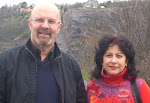
I recently finished the first draft of a book I've been trying to write about my experiences in Sardinia since I arrived here in November 2009 (and my visits before then) so, just to test the waters so to speak, I thought I'd start to serialise it in this blog with the hope that it attracts a bit more interest. I also intend to translate it into Italian but that's quite a large undertaking with which I'll be needing quite a bit of help. With this blog, after I've written the English version I translate it into Italian (for the Italian version) and then ask my wife to correct all the errors before publishing!
Anyway, here's the first chapter:-
A Bristolian In Sardinia
Chapter One Prelude to a life-changing event
A Bristolian in Sardinia? That would be me. I am the Bristolian in Sardinia. Yes, after more than half a century of living in my native city, from the very day I was born in fact, I moved in November 2009 to Nuoro, the largest town in Central Sardinia (but only marginally larger than Barnstaple, the largest town in North Devon). So how did I get here and why did I come here? Well, I suppose the story has its roots in the strong impression that an extract from Gurdjieff’s book Meetings With Remarkable Men had on me when I re-read it in 1985. In the chapter Abram Yelov, he describes how Yelov became a phenomenon in the knowledge of languages. He quotes Yelov as saying:
'It's all the same. Our thoughts work day and night. Instead of allowing them to think about caps of invisibility or the riches of Aladdin's cave, rather let them be occupied with something useful. In giving direction to thought, of course a certain amount of energy is spent, but no more is needed for this purpose in a whole day than the digestion of one meal. I therefore decided to study languages - not only to prevent my thoughts from idling but also not to allow them to hinder my other functions with their idiotic dreams and childish fantasies. Besides, the knowledge of languages can in itself sometimes be useful.'
I remember re-reading this passage just as 1985 was about to turn into 1986, about eight years after having first read the book, and it struck a very powerful chord in me. Not only had I always been prone to 'idiotic dreams and childish fantasies', but I had also always had a desire to be fluent in another language other than my own native English and I was sensitive to the fact that, generally, we English are so linguistically inept. So, I formulated my extraordinarily naive and ambitious New Year's Resolution for 1986: I would be fluent in another language by the end of the year. And as French was one of my better subjects in my years at school French would be the logical language to choose. Of course, at the time, I had no idea how naive and ambitious such an undertaking was (without actually going to live in France) but, by and large, the results of my efforts were extremely positive and are still with me today. But today, nevertheless, I cannot claim to be fluent in French. Far from it, and in recent years I have not been able to sustain the enthusiasm I once had for actively studying the French language. Destiny had other things in store for me and it was another language that she wanted me to speak.
So what actually happened in 1986? Well, by late Spring I was becoming seriously involved with a young woman who was a Modern Languages graduate and spoke fluent French and German. She turned out to be very patient and helpful and was key in enabling me to brush up the schoolboy French I did know and turn it into something more. We became engaged in September of that year but, sadly, the relationship did not last and we parted two years later.
In the late 1980s I used to visit my parents on Sundays, staying at their house for Sunday lunch and for most of the rest of the day. They liked to watch the BBC language programmes that were broadcast regularly mid-morning on Sundays (my father was especially interested in languages) and this served as an extra stimulus for me. During that time I had started to do some basic study in Spanish and German but as my fiancé was working as a bilingual secretary and was given the opportunity by her company to start learning Spanish her knowledge of the language outstripped mine in no time! I suppose, after the relationship was over, the competitive side of my nature wanted to learn a language that she didn’t know! One day, when I found myself browsing through the bookshelves in W.H.Smith’s in Kingswood (not far from where my home was then in St George in East Bristol), I saw the book of the BBC Italian Course for beginners Buongiorno Italia and felt compelled to buy it. I actually worked my way through the book, and the cassettes that came with it, fairly quickly and felt myself drawn to the Italian language far more than I had felt myself drawn to Spanish or German, or perhaps even French. I then bought the book of the second-stage follow up course L’Italia Dal Vivo and I worked my way through that fairly quickly too. And in the autumn term of 1990 I enrolled for a night-school class in Italian which was based around L’Italia Dal Vivo and took place at Cotham Grammar School. I enjoyed the class but after one year that was the end of it and it is rather unlikely that my Italian at the time would have stretched to much more than a few basic phrases and conversational pieces for use when going on holiday to Italy.
In fact, it was not until Christmas 2007 that I first visited Italy when I went to Rome with my older brother Jim and my two nieces, Catherine and Helen. My mother had died earlier in the year, on June 13th to be precise, at the age of ninety and I was not too certain about how I would be spending Christmas as I had no close family still living in Bristol. So I was delighted that Jim had invited me to spend Christmas with them in Rome. About three months earlier I had started attending Italian night classes again, this time at Stoke Lodge in Stoke Bishop, and one of my principal reasons for enrolling was that Catherine, the older of my two nieces, was about to spend several months in Florence as part of her degree course in Italian. She was studying at Sydney University and Sydney in Australia was where she and Helen had grown up as my brother had lived in Sydney for eighteen years from 1986 before he returned to live and work in the UK. I liked the idea of visiting Florence and trying to communicate with the local people in their own language. As it turned out I didn’t visit Florence until April 2015 but my Christmas in the Eternal City in 2007 was an unforgettable experience. We stayed in an apartment that was about five minutes walk from the Colosseum so it was located in an ideal place from which to explore the historic part of the city, il centro storico as the Italians say. And I did get lots of opportunities to try out my Italian even if the puzzled expression on my face to some of the responses I got betrayed the fact that my understanding of spoken Italian was somewhat lacking! For the most part, when this occurred, our Italian hosts switched to speaking English (although not all of them were able to do so). All in all it was a wonderful week and I must say that the extraordinary architecture, the historic squares and fountains, the general ambience and the quality of food that we found in Rome were an absolute delight.
Back in Bristol I think it’s fair to say that the weekly Italian evening classes had become the highlight of my week. This was due in no small part to the splendid teacher we had in Maria who was from Puglia originally but had settled in Bristol after marrying an Englishman. She was so enthusiastic that it rubbed off on all of us and she had some very effective methods of teaching which included improvised drama with us students speaking exclusively in Italian. If the class seemed rather tired from a day’s work before we were due to begin she would have us up off our seats and walking around the classroom in order to liven us up, at the same time giving us simple physical exercises with the instructions of course in Italian. Anyway, in March 2008 David, one of the other students in the class, gave me an address of a website that he said was a great help in acquiring a wider range of basic Italian phrases. It was a very long website address and when I typed it into the browser of my PC nothing showed up. However, after doing a short search I did discover a website called MyLanguageExchange.com, a website that that enables you to learn and practise foreign languages with native speakers through a process of interaction with them. Furthermore, well over 100 languages are catered for on the site. After I had registered I sought out native Italian speakers who wanted to improve their English and I found several of them with whom I started to communicate. The site has a textchat facility that enables this kind of exchange. A couple of weeks after I had started to use the site I made contact with Maria Rita, the Sardinian lady who would later become my wife, and I was soon communicating with her to the exclusion of all the others. Before long we were talking to each other via Skype every day and, just as the Italian evening class had become the highlight of my week, this exchange with Maria Rita became the highlight of my day.
At the beginning of April Maria Rita and I had a most interesting exchange via Skype. She told me that it was important to know the Italian swear words so that the next time I came to Italy I would understand the spoken language a little better (and also whether or not I was being insulted!) However, she did warn me that it was not a good idea, when speaking with people I didn’t know particularly well, to sprinkle the conversation too liberally with Italian swear words! I soon learnt that vaffanculo (go fuck yourself) was una parolaccia molto forte (very strong swear word). Then there was cazzo (literally “prick”) although “non ho voglia di fare un cazzo oggi!” was like saying: “I don’t want to do fuck all today!” It’s rather amusing how swear words and the expressions that make use of them are the things that stick with us the most when learning a new language! Then there was also the comic misuse of each other’s languages during our exchanges. On one Sunday evening, after I had watched Inter beat Udinese in an Italian football match on Channel 5 that afternoon, I said, “mi é piacuta la partata” thinking I had said, “I enjoyed the match.” “What did you say?” asked Maria Rita. “Patata is slang for pussy! You just said that you enjoyed the pussy! I don’t speak to you no more!” (Incidentally, it’s actually grammatical to use a double negative in Italian so it’s quite an understandable error for Italians to make when speaking English.) Of course she was joking, knowing that the word I had meant to use was partita (which does mean “match” when used in a sporting context). There was also the occasion when Maria Rita said, when talking about her brother Raimondo who lived in the apartment above her, “my brother is on top of me.” This time it was my turn to warn her that if she said such a thing in English we might think that she was talking of incest. “Oh no! You can’t think to that!” came the concerned reply. (In Italian they say pensare a which literally does mean “to think to” when in English we would say to think of or to think about.)
I think it is fair to say that this regular daily contact greatly improved our respective knowledge of each other’s languages. I was now under no illusions about the difficulties of learning to speak a language fluently and I had long since come to the conclusion that it would be necessary for me to live in the country where the language was spoken, for a reasonable period of time, for me to achieve my ambition of fluency in another language other than English. With Maria Rita there seemed to have developed a very strong connection between us very quickly but despite my growing desire to vist Italy more often, and perhaps for longer periods, because of the practical constraints I was not expecting our growing friendship to develop into a great deal more. I was still convinced that Nuoro in Central Sardinia, where Maria Rita came from and still lived, was not the easiest place to travel to from Bristol. So when she told me that she was looking into the possibility of travelling to Bristol to meet me it came as quite a surprise. She told me that there were direct flights from Olbia to Bristol, Olbia being the nearest airport to Nuoro. When I checked I was astonished to discover that she was right. Easyjet had just launched a new seasonal service.
So, towards the end of June 2008 Maria Rita travelled to meet me. Her flight was due to arrive in Bristol fairly late on Thursday evening the 26th with her return flight to Olbia being on Saturday the 28th. I had an Italian class on that evening and was planning to drive to Bristol airport to meet her when the class finished. While the class was actually in progress I was receiving text messages from Maria Rita, first to say that she had checked in at Olbia, then that there was a problem with the flight being delayed and finally to say that she was not able to come! This really set the alarm bells ringing! Apparently the pilot had been taken ill and there was no replacement. It later emerged that the only way that Maria Rita would be able to reach Bristol was by flying to London Gatwick and then take the National Express coach to Bristol. This meant that she would not be arriving in Bristol until fairly late Friday morning and her return flight was just twenty-four hours later! Maria, the Italian teacher, was very sympathetic and even spoke to Maria Rita on my mobile after the lesson. Maria Rita herself was in tears and I was feeling increasingly disconsolate. After the evening class was over, instead of driving to the airport, I went home and being something of a football fan I tried to watch the football on TV. It was Spain versus Russia in the European Championships but I could neither relax nor concentrate. I tried to go to bed and sleep but my mind was far too active. I did get a message from Maria Rita to say that the flight to Bristol was now back on and would arrive in Bristol around about 3.30 AM the following morning. At about twenty past midnight I got into the car and drove to Bristol airport as I was finding it impossible to settle at home. And there I stayed for the rest of the night until the flight arrived, pacing up and down, drinking several cups of coffee and becoming a little frustrated about the fact that there was no information about the flight from Olbia and no staff on duty to whom one could address enquiries. The only staff working in the middle of the night seemed to be the waiters and waitress at the two cafés that were still open.
Finally, at about five o’clock in the morning, Maria Rita appeared. She looked exhausted and a little apprehensive. Nevertheless, outside the sun was beginning to rise and we were able to relax as we walked to the car park. Despite the fact that I had had no sleep I was not in the slightest bit worried about driving home. I felt wide awake. To arrive in Bristol from the airport one has to drive along the A38 through the Bedminster Down district. From there there are splendid views of the Georgian terraces in Cliftonwood and Hotwells and of the Clifton Suspension Bridge which spans the River Avon. Maria Rita was very taken by how spectacular she thought the Avon Gorge was. “Che bello!” she said as I drove along the Portway towards Bridge Valley Road and she looked up at the bridge about 350 feet above the river. “Che bella la vegetazione!” she said when I drove up Bridge Valley Road and as we passed Bristol Zoo we argued about the pronunciation of the word ‘zoo’. In Italian it is spelt the same way but the pronunciation is more like ‘zow’ (rhyming with ‘tow’). When I neared my home in North Bristol, and we could see a part of the Severn Bridge from the top of Henbury Hill and just about make out the Welsh mainland, she marvelled about the fact that we were so close to Wales.
So now it was Friday. We had just one full day together. I was really taken aback by the number of gifts that Maria Rita had brought over for me from Sardinia and I felt a little guilty about not having reciprocated her generosity. Among them there were some genuine examples of traditional Sardinian culture: its wine, pecorino cheese and pane carasau, a traditional Sardinian flatbread, thin and crisp and shaped rather like poppadoms but much lighter in taste. We found it difficult to rest very much and later in the day we went for a walk in the woods of Blaise Castle Estate not far from my home. Blaise Castle Estate was once a stately home but is now a large area of parkland and woodland managed by Bristol City Council. We also had some refreshment in the outdoor café there and Maria Rita was amused to read that they sold ‘paninis’. “But ‘panini’ is the plural!” she exclaimed. In the evening we went for a pub meal in the Victoria, a rather charming pub in Westbury-on-Trym about five minutes’ drive away.
 |
| My drawing of The Victoria Pub |
We continued to talk to each other every day via Skype and it was not very long, as it happened, before Maria Rita was proposing to visit me again, this time in August when she had some leave to take from the Post Office where she worked and no plans as to what to do with the time. Unfortunately, it was very difficult for me to get time off from my Civil Service job for the period she had in mind but I did manage to book a couple of days’ leave, giving us a long weekend and four full days together near the beginning of August. This time we were able to do things at a more leisurely pace. I was able to show her around Central Bristol. We visited the cathedral, the harbourside and the museum as well as Clifton Village and the Clifton Suspension Bridge. I also introduced Maria Rita to my friends Simon and Paula for the first time. They shared a Sunday morning coffee with us and said that Sardinia was on their list of prospective holiday destinations but that it seemed rather expensive. Maria Rita explained to them that the Costa Smeralda in the north of the island, which dominates most of the holiday brochures, is in fact extremely expensive. But this is because it is is where the jet set go and where they often have holiday homes. However, as I have been told myself many times by quite a few Sardinians, “La Costa Smeralda non è la vera Sardegna!” Maria Rita went on to explain how much of the true culture of Sardinia is concentrated in the centre of the island and a province like Ogliastra, which is on the east side of Central Sardinia and has a stunning coastline, is every bit as beautiful as the Costa Smeralda and about three or four times less expensive. The only drawback is that it is located some distance from one of the major airports and getting around by public transport in Sardinia is not easy.
On Monday 11th August, the day before Maria Rits flew back to Sardinia, we visited Bristol Zoo. I had been very surprised to learn from Maria Rita, considering the island has a land mass which is actually a little larger than the whole of Wales, that there are no zoos in Sardinia. So she was very keen to go. There were two things in particular that I remember about the visit. Firstly Maria Rita was a bit taken aback by the size of the bats and not a little frighteneed by the fact that they seemed to be allowed to fly about a little too freely for her comfort. Secondly, when we were looking across at the gorillas at that part of the zoo which is called “Gorilla Island” I said, “I bet those gorillas are thinking ‘who are those stupid people staring at us?’” Maria Rita then responded with the following: “Yes, they’re saying ‘who are those fucking people?’” There was a large party of very young schoolchildren right next to us, most of whom must have heard what she said. After the teacher gave us a questioning look I whispered in her ear, “you don’t use that word within earshot of young schoolchildren!” But I couldn’t help laughing. On another occasion, during Maria Rita’s next trip to Bristol to see me, we visited Blaise Castle House Museum where there was a wonderful collection of antique and pristine looking lavatories.
 |
| My drawing of Blaise Castle House & Museum |
All things considered we had a wonderful few days and of course continued to talk via Skype when Maria Rita was back home. I had often spoken to Maria Rita about the peculiarities of the Bristol accent and given frequent demonstrations to her of the accent at its broadest, something I’m extremely prone to do ordinarily anyway! One evening when we were chatting away on Skype she told me about how an English tourist had entered the Post Office shop where she worked and when Maria Rita had asked the girl where she was from she said that she was from Bristol. “So I said to her ‘Ah I know Bristol. I have a friend in Bristol. I have been there two times this year. Babber!’” Obviously the young Bristolian girl on holiday in Sardinia found the use of this Bristolian term of endearment in Central Sardinia hysterical because Maria Rita told me that they couldn’t stop laughing after that. It’s also rather strange for a Bristolian to hear the word “babber” said with the rolled R of Italian pronunciation!
Now it was my turn to visit Sardinia and I was longing to make the journey even if I was a little nervous about it. Unfortunately, by the time I was ready to visit Sardinia at the beginning of November, the seasonal flights from Bristol to Olbia had long finished. So I booked a flight from London Heathrow to Rome, where I met Maria Rita, and then we flew to Alghero together. From Alghero we took a coach to Nuoro (although it was more like a minibus!) and we arrived at Maria Rita’s apartment at around half-past one on the morning of Monday 3rd November. “Che bello!” she said when we arrived. I thought she had said “Capello” and that she was referring to Fabio Capello who was manager of the England National Football team at the time. We both laughed. My mother used to say that my older brother’s hearing was always more acute than mine, right from the days when we were both children.
After a good night’s sleep my first full day in Nuoro was very agreeable. I can remember looking out from the balcony of the 4th floor apartment at a convent on the top of a hillside, beyond the other apartment blocks in view, and thinking: “Am I really here?” Even though I had travelled to Australia, France, Germany and Italy before I have never really been a seasoned traveller. Any new destination that I arrive at fills me with a sense of wonder. Throughout the course of the day we took things fairly easily. I was introduced to Maria Rita’s younger son Alessio, her niece Sarah, Jessica the girlfriend of her older son Pierpaolo who was out at work during the day, and Jessica’s sister Caterina. Alessio has a keen interest in street art and is quite a talented artist himself. He showed me some photos of some of his designs and when I told him that I was from the same city as Banksy his response was to say: “Dai!” which, in that context, is rather like saying: “No way!” in English. Jessica and Caterina cooked a rather splendid pranzo (lunch) in my honour, a mix of pasta and traditional Sardinian dishes, which was wonderful but incredibly filling. I naively worried that I might be expected to always eat such ample portions if I were to be living in Sardinia permanently! In the early evening Maria Rita took me to see Monte Ortobene, a small mountain just beyond the city, and la statua del Redentore (statue of Christ the Redeemer), a rather splended sculpture in bronze near the mountain’s summit. From the other side of the summit there was a very clear view below of Oliena, the nearest town to Nuoro and the hometown of the famous ex-Chelsea and Italian international footballer Gianfranco Zola. When we returned to the apartment I met her other son Pierpaolo. He seemed quieter than the others but as he was probably tired from having been at work all day this was no great surprise.
During the course of my ten day visit to Sardinia we visited the Museo di Grazia Deledda located in the house whch was actually the birthplace of the Nobel Prize winning author from Nuoro. Grazia Deledda is not a particularly well-known author in the English speaking world, as most of her books have been translated into English only comparatively recently, but as one might expect of a Nobel Prize winner she is a very celebrated author in Italy. We also went to the Museo Etnografico Sardo (Museum of Sardinian Life and Folk Traditions) which, like the Museo di Grazie Deledda, was within walking distance of Maria Rita’s apartment and was full of wonderful exhibits of traditional Sardinian costumes, many of which are only worn during parades or festivals. We also went to Lotzorai, a small town in the province of Ogliastra about an hour’s drive from Nuoro, where Maria Rita’s family have a holiday home divided into four separate apartments, one each for her, her sister Patrizia and her two brothers Raimondo and Mariano. There are some lovely seaside towns nearby, like Santa Maria Navarrese, and interesting small towns like Tortoli and Arbatax. Furthermore, the surrounding scenery is very impressive.
 |
| My drawing of the Museo di Grazia Deledda |
One very important difference between the Italians (especially the Sardinians) and the British is that the Italians have a much healthier attitude towards eating. The sort of thing that you hear in offices in every part of the UK at lunchtime, eg: “I’m just going to grab a quick sandwich and I’ll be back at my desk in five minutes”, is anathema to the Italians. When we had lunch with Patrizia and Gianfranco on Saturday Gianfranco said to me: “In Italia il pranzo è per la famiglia….. sabato, domenica soprattutto….. piano, piano….. parlare, mangiare, parlare, mangiare.”
When we returned to Nuoro from Lotzorai Maria Rita took me via the old road, the scenic route, and told me to enjoy the scenery and although the scenery was breathtakingly beautiful I found it very difficult to enjoy it. The reason being was that we were driving along one of those mountain roads, the like of which one doesn’t find in the Bristol area, and for much of the route there was such a sheer incline beyond the crash barriers that I was actually feeling rather nervous. In England I was used to having to brake much more frequently than was necessary here. It was about every twenty minutes that we actually saw a car coming in the opposite direction. I was much relieved when we arrived in Oliena and took some refreshment in one of the bars there. Obviously the men watching the football, which was on the TV inside the bar, weren’t fans of Inter who were being managed by Jose Mourinho then. “Bastardi!” they cried when Inter scored a winner in injury time.
I returned to England on Tuesday 11th November, flying first from Alghero to Rome and then from Rome to London, Heathrow. I stayed overnight in Alghero with Maria Rita the evening before my return flight and this gave me the opportunity to see another extremely attractive Sardinian town with exquisite architecture, much of it a legacy of Alghero’s strong connection with Spain from a few centuries ago when Sardinia was under Spanish rule. Although the Sardinians have their own language, Sardo, with a huge range of different dialects, many residents of Alghero actually speak Catalan and the language is co-official in the city. Neverthless, Italian is the official language of Sardinia and all school lessons are conducted in Italian.
Maria Rita sometimes has a rather quaint way with the English language. In Alghero we ate out at a local restaurant in the evening and while we were talking she could sense a slight reticence on my part to return to Sardinia until the the summer season Easyjet flights from Bristol to Olbia had resumed the following year. Believing this to be a rather poor excuse for not returning to Sardinia earlier she told me, “that is a bullshit!” using the indefinite article where it is never used ordinarily in English. However, it is a quite understandable error because the closest translation in Italian would be: “è una stronzata!” where the indefinite article is always used. Needless to say this works both ways because people have often poked fun at my rather anglicised manner of speaking Italian over the last few years. I remember causing amusement once with the way I responded one lunchtime to being asked: “Altre due?” (literally ‘”another two?” but its simply a way of asking if you would like a little more to eat.) “Solo uno” (just one), I said, not fully understanding what I was being asked. Everyone laughed. Curiously enough Maria Rita will often ask me: “Do you want other?” when in English we would usually say: “Do you want more?” But that is how they say it in Italian: “Vuoi altro?” Altro means ‘other’.
When I was back in Bristol we continued to communicate daily via Skype. Maria Rita did wonder about coming over to England for Christmas but she was unable to take sufficient leave from work over the Christmas period for it to be really practical. I spent Christmas 2008 with my brother Jim and my niece Helen at Jim’s house near Leaminton Spa in Warwickshire. Maria Rita stayed in Nuoro and celebrated with the rest of her extended family but we did remain in touch throughout.
Maria Rita visted Bristol for the third time at the end of January 2009. With no direct flights from Sardinia to Bristol at this time of year she decided to fly to Milan and then from Milan to Bristol. What a nightmare it turned out to be! I remember being a bit worried because there was very little turnover time between her flight from Alghero to Milan and then the flight from Milan to Bristol, no more than a couple of hours at the most. The fact that the flight from Alghero to Milan was delayed because of striong winds obviously did not help matters. When she eventually arrived at Milan she made a mad dash for the check-in desk for the Bristol flight but it was closed moments before she arrived there. She was told that she would instead have to fly to London Stansted and then get a National Express coach to Bristol from there. I was kept in touch about everything that was happening via mobile phone. I had no idea what to do! All sorts of thoughts were racing through my head. Should I drive to Stansted and meet her there? Or Heathrow where she would have to change coaches for Bristol? But I had never driven to either airport before and because of the size of both and my unfamilarity with the arrangements for visitors’ car parking I was afraid that I might miss her if I did so. Furthermore, there was a choice of two National Express coaches, one that changed for Bristol at Victoria in London and the other at Heathrow. In the end I decided to stay in Bristol and it proved to be the right choice. Maria Rita caught the coach to Victoria in London (so I would have missed her had I driven to Heathrow) and then changed coaches for Bristol. She arrived at the Triangle near Bristol University at about two o’clock Sunday morning, about seven hours later than we would have met had she not missed the flight for Bristol from Milan. It was very wet, very cold and very windy but what a relief and what joy! We made our way to where I had parked the car nearby just as hoardes of young people were coming out of a club, the girls mostly dressed in short skirts and flimsy tops as if they were still on their summer holidays on the continent! “Are they mad?” Maria Rita asked me.
Despite the inauspicious start to the week we did have a very enjoyable and sociable time, meeting lots of friends, enjoying some live music and I took Maria Rita to see the Roman Baths in Bath as well as The Georgian House and the SS Great Britain in Bristol. We also went to the Concord Museum which was run by a team of volunteers on the site of British Aerospace in Filton, the British home of that Anglo-French project. Maria Rita was not particularly well the following Saturday and we had to cancel our plans to see one of my favourite local Bristol bands The Bones at The Prom, a live music venue in Gloucester Road (which has since changed hands and changed its name). However, she had recovered sufficiently to be able to fly home the following day, Sunday 1st February. When I arrived back home that day, after having seen her off at Bristol airport, everything seemed rather flat.
I had mentioned to Maria Rita that in my line of work we had the option of taking unpaid career breaks if we had good enough reason to do so. Because I had inherited some money after the death of my mother I could probably afford to take a six month career break, the minimum period allowed. My idea of course was to spend that time in Sardinia with Maria Rita and improve my Italian. She told me that I was welcome to stay with her for as long as I wanted. Two and a half weeks after Maria Rita had returned home I put in an application for a career break at the office. When my line manager spoke to me about it she was very reasonable but told me that it was not a ‘given’ that a career break application would be approved and that the needs of the business had to come first. It certainly prevented me from raising my hopes too high and when I learned on Tuesday 3rd March that my application had been turned down it was no great surprise but it was a disappointment. As events turned out over the next few months it proved to be a blessing in disguise.
The next time Maria Rita and I met was in the late Spring when I made my second visit to Sardinia, staying there for a fortnight. I flew to Rome from Bristol where I met Maria Rita and then later in the day we flew to Alghero before travelling on to Nuoro, arriving there in the early hours of Sunday 26th April. If anything, this trip very much strengthened my desire to go to live in Sardinia, at least for a period of a few months. We took things at a very leisurely pace for the most part, pottering around in Nuoro and then travelling to Lotzorai with Gianfranco and Patrizia on the Thursday. The following day while Maria Rita and I were out for a walk just outside Lotzorai I remember saying to her: “Per me, adesso, questo posto è il posto più bello del mondo.” “Gianfranco and Patrizia always say this,” she replied in English. But I had had one of those ‘peak’ moments when I felt inseparable from the beauty of the surroundings. And once again all the places within a few minutes’ drive from Lotzorai were a sheer joy to visit.
On Tuesday the 5th May, after we had returned to Nuoro, we went out with Maria Rita’s English friends, Pete and Christine, whom I had met before on my first visit to Nuoro. They were originally from Coventry but had decided to take early retirement and move to Sardinia. We went to a quite delightful place, about halfway between Nuoro and Oliena, called Sorgente Su Gologone, which reminded me of parts of Blaise Castle Estate and Snuff Mills (two of the most beautiful places in Bristol) with its rocks, its stream running from a natural spring and nearby woodland. But it was on a larger scale and more spectacular. We then had a wonderful meal in the very impressive Su Gologone restaurant, part of a larger complex which includes a hotel and an art gallery. Christine told me how Madonna had stayed there during the filming of the movie Swept Away. Word has it that Stella McCartney and Richard Gere are among the other celebrated guests who have stayed there.
Afterwards we went to Pete and Christine’s house, not very far away, in the countryside just outside Oliena on the way back to Nuoro. I will never forget how I felt looking out from their garden at the very impressive view of the Supramonte mountain range the other side of Oliena. Sheer bliss. I remember how at that moment I asked myself what I had actually been doing with my life. There were so many beautiful things and places in this world that I had never seen. Yes, much as I liked my native city of Bristol, and I felt so at home there, I was beginning to feel more and more drawn to the idea of actually living in Sardinia.
The following day Pete and Christine were planning to go to Cagliari and very kindly offered to take us with them to give me an opportunity to see another part of Sardinia. Cagliari is the capital city of Sardinia and about two hours’ drive south of Nuoro. If my memory serves me correctly Christine had some business that she had to attend to there regarding some relatives that she had managed to trace online. Cagliari made a very favourable impression on me. It was very bright and lively where we were for most of the day, in the main part of town very close to the ferry port, and as with so much of Sardinia I was struck by how attractive much of the architecture was.
Two days later, with my holiday nearly over, we went to Rome where we stayed overnight. In Rome I met Maria Rita’s niece Chiara, daughter of Gianfranco and Patrizia, for the first time. She has lived in Rome since finishing university and we had a very enjoyable time eating out with her, her boyfriend Gennaro and another relative Sylvia, a first cousin to Chiara and first cousin once removed to Maria Rita. (In Italy all cousins once removed, of the next generation, are nieces or nephews. Rather more sensible I think!) And then, the following day, on Saturday 9th May I flew back to Bristol from Rome while Maria Rita returned to Sardinia.
I got quite a shock when I arrived back at my house in Bristol. There was a damp patch on the ceiling of the living-room. It turned out to be a problem with the boiler which was situated in the back bedroom upstairs. When a British Gas engineer called a few days later he told me that the boiler was done for and that it would have to be decommissioned and replaced. It would cost at least £2,000 to replace it! He also told me that had I left it much longer it could have brought the living-room ceiling down. Had the career break that I applied for earlier in the year been approved I would have probably left for Sardinia in the spring. So the fact that my request was turned down was a blessing in disguise because only heaven knows what would have happened to the house had I left it empty for several months with the boiler in that state! Furthermore, when the boiler was replaced I discovered that there was essential work that needed doing to the roof. That summer turned out to be quite expensive!
It was just three weeks after I had left Sardinia that Maria Rita came to visit Bristol for the fourth time. She stayed with me for the first week in June. I remember that on the Monday and the Tuesday we were a bit restricted as to what we could do because on those days British Gas came to fit a new combination boiler in the house. Then on Wednesday I drove up to Stratford-On-Avon as she was interested in seeing Shakespeare’s birthplace and we had a very enjoyable time visiting the house in which Shakespeare was born and looking around the town for a few hours. As my brother Jim lives only a short drive away from Stratford-on-Avon we met up with him later on and had a rather splendid meal that evening in a French restaurant in Leamington Spa. We stayed overnight at Jim’s house and then visited Warwick Castle the following morning after Jim had gone to work. This was an absolute delight for Maria Rita who had long harboured an ambition to visit a genuine and historic English castle. Before first visiting me in Bristol the only part of England that she had visited was London. Now, little by little, she was discovering other parts of the country. We travelled back from Warwick to Bristol around about midday and a couple of days later, after a week of extraordinarily good weather, she flew back to Sardinia on Saturday 6th June.
I returned to Sardinia for two more visits that summer. The first time was in July when we stayed for almost the entire week in Lotzorai and then the second time was at the end of August and for the first few days of September. At Lotzorai I met some more of the closest members of Maria Rita’s family for the first time: her brother Mariano and his wife Maria Antonietta, their daughter Tiziana and their younger son Nicola, and also Tiziana’s husband Joserra and Nicola’s girlfriend Federica. The second time I stayed at Nuoro for the entire week because Maria Rita had to work and in Nuoro one evening I met Stefano, the son of Patrizia and Gianfranco, for the first time. None of the problems that I had with the house that summer had dampened my enthusiasm for the idea of going to live in Sardinia, at least for a substantial period of time. I had put in an application for early retirement from the Civil Service at the end of June. It seemed like an age before Capita, the HR firm that dealt with our pensions, informed me that I had passed the Guaranteed Minimum Pension Test, meaning that I would qualify for the full State Pension when I reached the age of sixty-five. Finally, I received a written notification to this effect on Wednesday 26th August which meant that I could hand in my notice and take early retirement as soon as it was possible.
Friday 30th October was my final day in the Civil Service. My colleagues organised a fabulous buffet in my honour which we all tucked into at lunchtime just after I had given a pre-prepared leaving speech, the humourous parts of which (or what I thought were the humourous parts) fell completely flat! Throughout the day I was feeling rather light-headed. It was only when I was saying goodbye to my colleagues individually that I felt rather emotional. Ten days later I would be starting a new life in Sardinia. I had never expected to be able to retire early, at the age of fifty-five, and before I met Maria Rita I was quite resigned to the fact that I might be on my own for the rest of my life, that I would have to go through the motions at work until I was sixty years of age and able to draw my full Civil Service Pension; and then after that I would look for a part-time job to supplement my income, at least until I was able to draw the State Pension at the age of sixty-five. It all sounds terribly dull but I was just resigned to the fact that this was the way that things were likely to be and I was no longer afraid of things turning out that way. Nevertheless, I had never lost hope of having a different and more interesting future but I hardly expected to end up living in Sardinia!
© Geoff Davis